The Radical Pleasure of Stillness: How the Finest Beach Clubs Are Making Space for Nothing at All
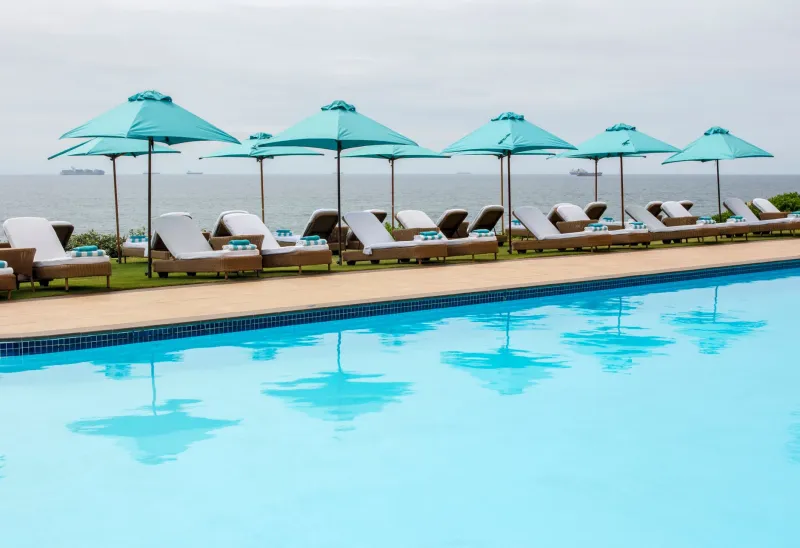
There is a particular kind of exhaustion that no amount of sleep can remedy. It is the fatigue that accumulates not from physical exertion, but from the relentless demand to be productive, purposeful, and perpetually engaged. It is the weight of the optimized life — the calendar blocked to the quarter-hour, the inbox that never empties, the nagging sense that leisure itself must be justified by some measurable outcome.
For a growing number of America's most accomplished travelers, the antidote is not another itinerary. It is, counterintuitively, the deliberate embrace of nothing.
Along the country's finest coastal retreats, a quiet but meaningful shift is underway. The most sophisticated beach clubs are no longer competing on the density of their programming. Instead, they are competing on the quality of their emptiness — and discovering that true luxury, in this particular cultural moment, may be defined less by what is offered than by what is thoughtfully withheld.
The Productivity Trap and the Longing for Release
American culture has long held an uneasy relationship with rest. The Puritan inheritance runs deep: leisure, to be acceptable, must be earned. Even vacation has been colonized by the language of self-improvement. We do not simply swim; we "get our steps in." We do not sit with a book; we "work through our reading list." We do not gaze at the horizon; we document the horizon for an audience of strangers.
Psychologists have a term for the compulsion to fill every unstructured moment: "structured procrastination avoidance," though perhaps the simpler diagnosis is that modern Americans have forgotten how to be bored — and forgotten, too, what boredom was always quietly doing for them.
Research from institutions including the University of Central Lancashire and the University of Virginia has suggested that periods of unstructured mental rest are not merely pleasant but functionally necessary. They support creative consolidation, emotional regulation, and the kind of associative thinking that deliberate focus actively suppresses. Boredom, it turns out, is not the enemy of productivity. It is its silent collaborator.
This is the intellectual foundation upon which the most thoughtful beach clubs are now building entire philosophies of hospitality.
Designing for Drift
At the finest coastal properties, the architecture of genuine leisure begins long before the guest arrives. It is encoded in the physical environment itself — in the deliberate ratio of seating to open space, in the absence of screens from communal areas, in the placement of a chaise longue at precisely the angle that invites the eye to travel outward rather than inward toward a device.
The best properties understand that stillness must be scaffolded. It cannot simply be declared; it must be made structurally available. A beach club that fills every hour with organized activities — however elegant those activities may be — is, in its own way, as relentless as the office environment its guests are attempting to escape.
The more considered approach involves what hospitality designers sometimes call "permissive emptiness": the deliberate creation of spaces and time blocks that carry no implicit expectation of use. A reading terrace that is never converted into a yoga studio. A stretch of private shoreline where no attendant approaches unbidden. An afternoon that arrives on the schedule as simply, beautifully blank.
The paradox, of course, is that engineering this kind of nothing requires considerable something. The cabana must be impeccably appointed so that no discomfort intrudes upon the guest's drift. The ambient sound — whether the natural percussion of waves or the carefully curated silence of a sheltered garden — must be protected from disruption. The service must be present without being felt, attentive without being intrusive. It is, in its own way, among the most demanding forms of hospitality to execute.
The Permission to Simply Be
For many guests, the greatest gift a luxury beach club can offer is not a novel experience but a form of social permission. The high-achieving professional does not need to be told how to relax; they need to be placed in an environment where relaxation requires no defense.
This is why the culture of a beach club matters as much as its amenities. When stillness is modeled — when fellow guests are visibly, unapologetically at rest; when staff members speak unhurriedly; when the pace of the property itself communicates that there is nowhere more important to be than here, now — the individual guest is released from the internal pressure to perform even their leisure productively.
Some of the most refined coastal clubs along the Eastern Seaboard and the Gulf Coast have begun training their staff specifically in the art of unhurried presence: how to approach a guest without creating urgency, how to offer without implying obligation, how to hold space without filling it. These are subtle disciplines, but their cumulative effect on the guest experience is profound.
Boredom as the New Amenity
It would be easy to dismiss the celebration of boredom as a marketing conceit — a fashionable rebranding of what is simply a less programmed vacation. But the guests who seek out these experiences are not paying for the absence of things to do. They are paying for a very specific kind of presence: the presence of themselves, uninterrupted.
There is a reason that the most sought-after coastal retreats are increasingly spoken of in terms that once belonged to the spa world — restorative, clarifying, renewing. The shore has always had a particular power to reorient the human nervous system. The rhythm of the tide is one of the oldest natural regulators of attention; it asks nothing of the observer except that they observe. A well-designed beach club amplifies this effect rather than overriding it.
The guest who spends three days at such a property — reading when the spirit moves them, swimming without purpose, watching the light change across the water for an hour without checking the time — typically departs not merely rested but genuinely reconstituted. They have, in the most literal sense, recovered something of themselves.
The Understated Sophistication of Knowing When to Stop
There is a useful analogy in the world of fine cuisine. The most accomplished chefs understand that restraint is not the absence of skill but its highest expression. The dish that arrives with twelve components and three sauces announces its effort; the dish that arrives with three perfect ingredients, impeccably prepared, communicates mastery.
The same principle applies to the design of a luxury coastal experience. The beach club that offers more — more activities, more dining concepts, more wellness programming, more curated excursions — is not necessarily offering better. The property that has the confidence to offer less, and to make that less feel absolutely complete, is demonstrating a far rarer kind of sophistication.
At Le Rivage, this philosophy is not an abstraction. It is expressed in every unhurried afternoon, every unscheduled hour, every moment of genuine stillness that the shore, at its most generous, has always known how to provide. The ocean has never required an agenda. The finest beach clubs are finally learning to follow its example.