Governed by the Moon: How the Finest Beach Clubs Let Nature Set the Itinerary
There is a particular kind of intelligence at work in a beach club that knows when to step aside. Not the intelligence of a perfected service sequence or a meticulously engineered arrival ritual — though both have their place — but the quieter wisdom of an establishment that understands it is a guest on the shore, not its proprietor. The finest coastal retreats in America have begun to orient their most coveted offerings not around the convenience of a printed schedule, but around something altogether more authoritative: the tide table.
The result is a form of luxury that cannot be replicated by any competitor, fabricated by any designer, or purchased outright by any budget. It is, quite simply, the experience of being present at the right moment on the right shore — and having every element of one's surroundings conspire to make that moment extraordinary.
The Tide Table as a Design Document
For most resort properties, the ocean is a backdrop. It is photographed, marketed, and viewed from a tastefully appointed terrace. At the most thoughtful beach clubs, however, the ocean is consulted. Tide charts are treated with the same reverence a sommelier extends to a vintage calendar. The question is not merely what the club wishes to offer, but what the water will permit — and when.
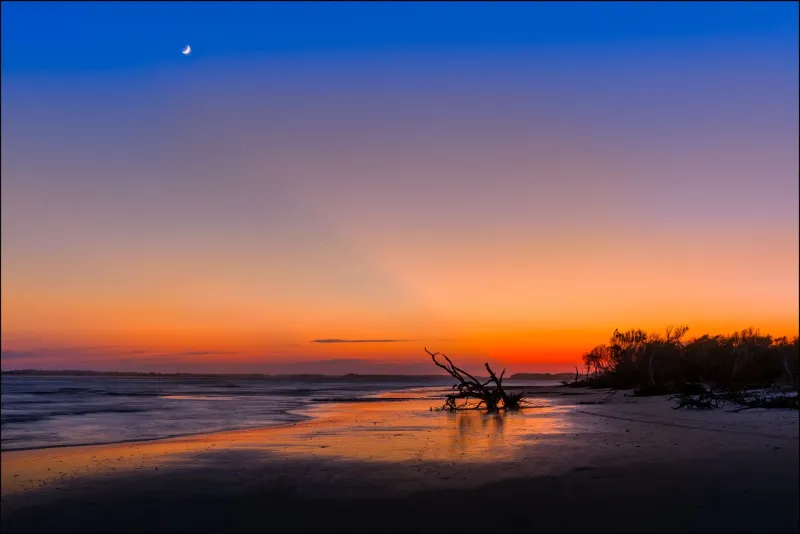
This distinction shapes everything. A low tide that exposes a quarter mile of firm, walkable sand at seven in the morning becomes the occasion for a guided naturalist walk, not a casual amenity but a curated encounter with the intertidal world that exists nowhere else and at no other hour. A new moon evening, when the sky above the Atlantic or Pacific darkens to its deepest register and the bioluminescent plankton stirs in the surf, becomes the organizing principle for a late-night gathering at the water's edge — intimate, unhurried, and entirely unrepeatable.
The scheduling implications are significant. Programming built around natural phenomena cannot be announced months in advance with the confidence of a fixed menu. It requires a different kind of communication between club and guest: one built on anticipation, trust, and the quiet understanding that the best experiences are, by nature, provisional.
Seasonal Phenomena and the Art of Anticipation
Beyond the daily rhythm of the tides, the coastal calendar is rich with phenomena that reward the attentive guest. The spring migration of shorebirds along the Atlantic flyway. The summer arrival of phosphorescent bays in Puerto Rico and the Florida Keys. The September king tides that transform familiar shorelines into something altogether unfamiliar. The winter swells that make the waters off the Outer Banks and California's northern coast a spectacle of raw, elemental power.
Elite beach clubs that have invested in natural literacy — hiring marine biologists as seasonal consultants, partnering with coastal ecologists, or simply employing staff who have spent years learning a particular shore — are able to translate these phenomena into experiences of genuine depth. A dinner timed to coincide with the peak of a king tide, with the water pressing closer to the table than any engineer would ordinarily permit, is not a gimmick. It is an act of theatrical courage, and it leaves an impression that no amount of imported marble or custom linen can match.
The appeal to the affluent American traveler is not incidental. A guest who has seen every five-star property from Turks and Caicos to the Maldives has, in a very real sense, seen the category. What they have not seen — what no amount of travel can provide without deliberate orchestration — is the specific, unrepeatable intersection of place, season, and natural event that a knowledgeable beach club can engineer around them.
Lunar Dining and the Return of Celestial Time
Perhaps no expression of this philosophy has gained more traction among America's most exclusive coastal properties than the lunar dining experience. Structured around the phases of the moon rather than the days of the week, these events unfold on a rhythm that feels ancient precisely because it is. A full moon dinner on a private stretch of beach — torchlit, unhurried, the table set at the exact point where the tide retreats to its lowest ebb — operates on a different register than any conventional fine dining experience.
The menu, naturally, follows the same logic. Shellfish reach their peak in the weeks surrounding a full moon, a fact long known to coastal fishermen and increasingly embraced by chefs who source directly from the water visible from their kitchen windows. A clambake timed to a September full moon on the Maine coast, or a raw bar curated to a July neap tide on the Chesapeake, carries a coherence that no amount of culinary technique can manufacture independently. The ingredients and the moment arrive together, and the guest is the beneficiary of both.
The Guest Who Learns to Read the Shore
What distinguishes the very finest beach club experiences aligned with natural rhythms is not merely that they are beautiful or well-executed. It is that they are educational in the most effortless sense — they return the guest to a form of environmental literacy that modern life has largely rendered unnecessary.
To spend a week at a club that explains why the water is calmer on Tuesday morning than it was on Saturday afternoon, or why the fishing is better on a falling tide, or why the sunset on the solstice warrants a specific vantage point that would be unremarkable on any other evening, is to leave with something more durable than a tan or a collection of photographs. It is to leave with a revised relationship to the natural world — and, by extension, to the particular shore where that revision occurred.
This is the alchemy that the finest beach clubs are quietly pursuing: not the delivery of a flawless product, but the creation of a guest who feels, perhaps for the first time in years, that they are living inside something larger than their own schedule.
Belonging to a Place in Time
The philosopher Simone Weil wrote that attention is the rarest and purest form of generosity. A beach club that structures its offerings around the tides is, in a sense, offering its guests the conditions for that kind of attention — not the distracted, photographed attention of the tourist, but the deep, participatory awareness of someone who has arrived at the right moment and knows it.
At Le Rivage, the conviction has always been that the shore is not a stage set. It is a living system with its own calendar, its own logic, and its own rewards for those who learn to read it. The most coveted experiences we offer are not the ones we invented. They are the ones we were perceptive enough to notice, and disciplined enough to build around.
The moon does not consult a hospitality consultant. But the best beach clubs, it turns out, consult the moon.