The Space Between: How the Most Refined Beach Clubs Design Emptiness as a Luxury
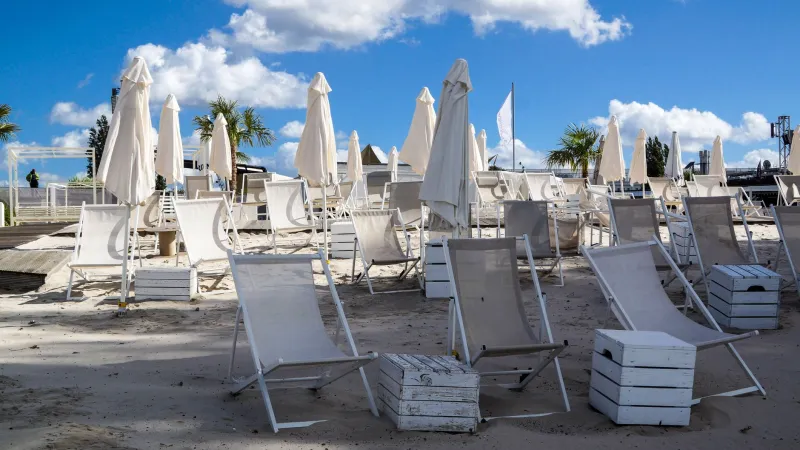
There is a particular quality of afternoon that belongs exclusively to the shore. The sun has moved past its apex. The lunch service has concluded. The water, still and unhurried, holds the light in long, flat planes. Nothing is required of you. And yet this moment—unremarkable on its surface—has been constructed with considerable care.
At the most discerning beach clubs along the American coastline, the experience of doing nothing is not left to chance. It is, in fact, the product of an elaborate and largely invisible design philosophy: one that treats the intervals between events not as voids to be filled, but as the experience itself.
The Tyranny of the Full Schedule
For years, the prevailing logic of luxury hospitality operated on a principle of accumulation. More offerings, more programming, more curated excursions—each hour accounted for, each amenity promoted. The implicit message was that value resided in activity, and that a guest's satisfaction could be measured by how thoroughly their time had been occupied.
The most sophisticated beach clubs have quietly rejected this model.
"The schedule is the first thing we edit," one hospitality director at a private Gulf Coast club noted in a recent industry discussion. "When you remove the pressure to fill every hour, guests stop managing their time and start inhabiting it."
This shift is not merely philosophical. It reflects a growing recognition among affluent American travelers—many of them high-performing professionals who spend their working lives in a state of relentless optimization—that what they seek at the shore is not more productivity dressed in linen. It is its opposite.
Sightlines That Slow the Eye
The architecture of absence begins, quite literally, with what a guest can see.
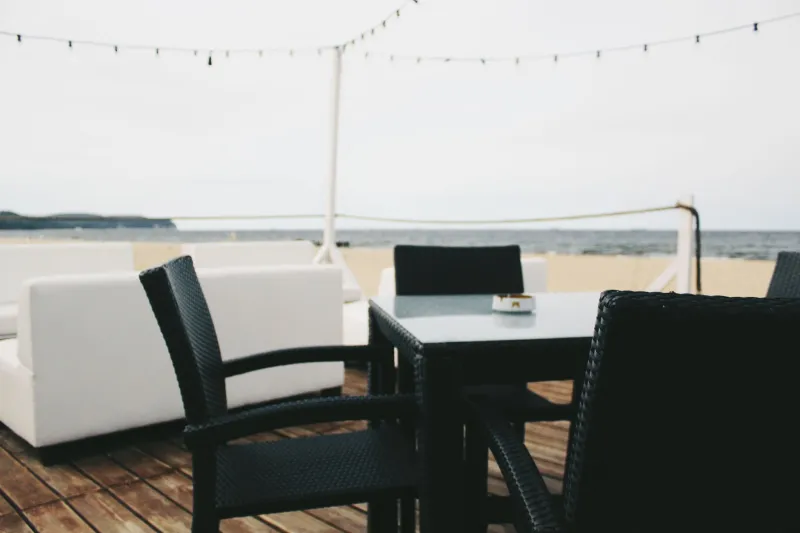
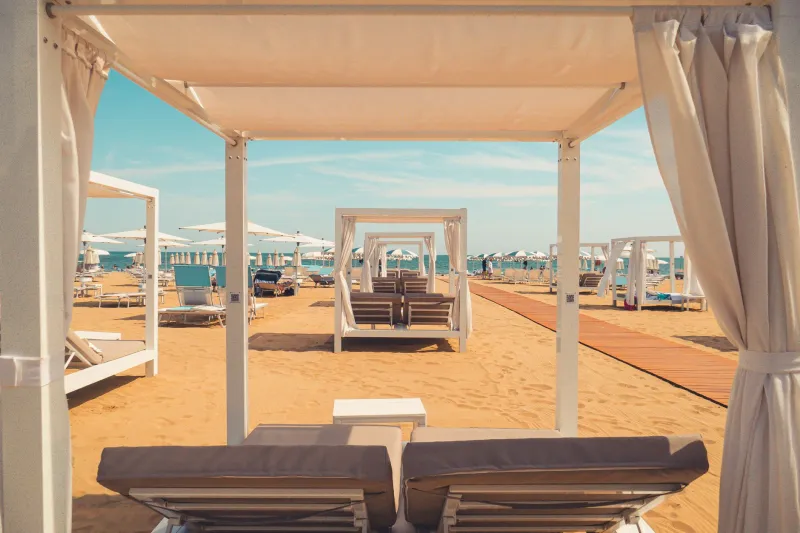
At clubs where this principle is taken seriously, the visual composition of each space is designed to resist urgency. Sight lines are drawn long and horizontal, pulling the eye outward toward the water rather than inward toward activity. Lounging areas are positioned to face open ocean or undisturbed dune grass rather than pools crowded with movement. Furniture groupings are generous in their spacing—close enough for conversation, distant enough for solitude.
This is not accidental. Designers working with elite coastal properties speak of "visual decompression zones," stretches of uninterrupted natural scenery that serve as a kind of palate cleanser for an overstimulated mind. The gaze, given nothing to resolve or navigate, simply rests. And in that resting, something essential begins to loosen.
Natural materials reinforce this effect. The soft gray of weathered teak, the muted warmth of sand-toned canvas, the quiet gleam of brushed stone—these surfaces absorb light rather than reflect it, reducing the subliminal agitation that highly polished or intensely colored environments tend to produce. The result is an atmosphere that does not demand attention. It simply holds it, gently.
The Interval as Amenity
Perhaps the most counterintuitive element of this design philosophy is its application to scheduling.
At the clubs that have mastered it, time itself is treated as a material to be shaped. Meals are spaced not merely according to culinary logic, but according to the emotional rhythm of the day. A late breakfast is positioned to allow for an unhurried morning walk. The gap before dinner is protected—no programming, no gentle suggestions from staff, no ambient noise that might suggest an expectation of sociability. This interval, typically ninety minutes to two hours in length, is offered to the guest as pure, unstructured time.
The effect is striking. Guests who arrive at the shore in a state of accumulated tension—the particular exhaustion of people accustomed to being needed—often describe these protected intervals as the first moments in months in which they have felt genuinely unobligated. The interval is not empty. It is full of a specific quality of presence that busyness forecloses.
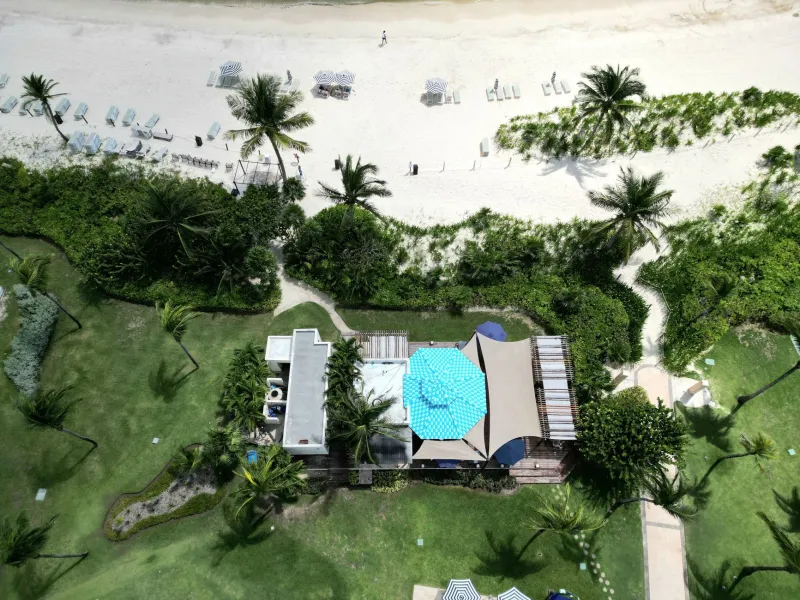
Some clubs extend this principle to their physical layout, incorporating what might be called "transition spaces": covered walkways, shaded alcoves, and shallow reflecting pools positioned between primary destinations. These are not shortcuts. They are deliberate slowings—places where the pace of movement naturally decelerates, where a guest moving from the beach to the dining terrace is invited, architecturally, to pause.
Sound, Silence, and the Acoustic Interval
The design of absence extends to the auditory realm as well.
Sound is among the most underappreciated elements of a luxury coastal environment. The finest beach clubs manage their acoustic landscape with the same intentionality they bring to their visual one. Live music, when offered, is positioned and scheduled to enhance rather than intrude—a quiet guitar in the late afternoon, distant enough from the primary lounging areas to register as atmosphere rather than entertainment. The hours between service periods are left to the natural soundscape: wind, water, the occasional call of a shorebird.
This restraint is harder to maintain than it might appear. The instinct of many hospitality operators is to fill acoustic silence with ambient music, reasoning that quiet feels empty and empty feels underserved. The opposite is true for a guest who has traveled to the shore in search of restoration. Silence, at the right moment and in the right setting, is not absence. It is presence of a different order.
The Staff Who Know When to Disappear
No discussion of designed absence would be complete without acknowledging the human element. The physical and temporal architecture of a beach club can create the conditions for meaningful intervals, but it is the behavior of staff that ultimately determines whether those intervals hold.
At the most accomplished clubs, service personnel are trained not only in the art of attentiveness but in the equally demanding art of withdrawal. They read the room—and the beach, and the terrace—with precision. A guest who has settled into stillness with a book and a half-finished glass of something cold does not require a check-in. A couple who have arranged their chairs to face the water and nothing else have communicated, without words, that they are not available for conversation.
The ability to honor these signals—to be present without being felt, available without being intrusive—is among the most refined skills in coastal hospitality. It is also among the rarest.
What the Pause Produces
The deeper argument for designing absence is not simply that guests find it pleasant. It is that the intervals between experiences are often where the experience itself is most fully absorbed.
A meal becomes memorable not only in its flavors but in the unhurried hour that follows, when those flavors are still present and the conversation has grown easy and the water is turning gold. A morning swim registers most completely in the quiet half-hour afterward, when the body is warm and salt-dried and there is nowhere to be.
The finest beach clubs understand this. They have built their environments—their sightlines, their schedules, their acoustic landscapes, their service philosophies—around the recognition that luxury, at its most evolved, is not the provision of more. It is the creation of the conditions in which less becomes, quietly and unmistakably, enough.