Silence as a Statement: How the Finest Beach Clubs Protect Privacy in a World That Cannot Stop Sharing

There is a particular kind of freedom that money alone cannot purchase. It cannot be delivered by a concierge, pressed into a welcome envelope, or listed among a property's amenities. It is the freedom to exist, fully and without performance, in a beautiful place — unobserved, undocumented, and entirely at ease. For the guests of America's most exclusive beach clubs, this freedom has quietly become the most sought-after luxury of the modern coastal retreat.
In a cultural moment when even the most private individuals feel the gravitational pull of the shareable moment, a handful of elite clubs along the Atlantic and Pacific coasts have chosen a different philosophy entirely. They have made discretion not merely a policy, but a point of distinction. The result is an experience that feels, to those fortunate enough to access it, almost radical in its restraint.
The Quiet Power of the Unposted Moment
To understand why privacy has become a genuine luxury, one must first reckon honestly with what has been lost. Over the past decade, the act of experiencing something beautiful has become inseparable, for many, from the act of broadcasting it. Dining tables are styled before the first course arrives. Sunsets are filtered before they fade. The horizon becomes a backdrop rather than a destination.
The finest beach clubs recognized early that this dynamic posed a specific threat — not merely to the comfort of their guests, but to the essential nature of the experience they were curating. When a private stretch of shore becomes a content opportunity, something irreplaceable dissolves. The hush of the water, the unguarded conversation, the afternoon that belongs entirely to the people living it — these things do not survive the lens.
And so the most thoughtful clubs began, quietly and deliberately, to build structures of protection around them.
Policies Written in the Language of Hospitality
The manner in which a club communicates its privacy expectations reveals a great deal about its character. The least sophisticated approach — the laminated sign, the blunt prohibition — solves the problem while creating another one entirely. It introduces a note of surveillance into a space meant for liberation.
The clubs that handle this most elegantly have learned to weave their expectations into the fabric of the member experience rather than posting them on a wall. New members receive orientation materials that frame photography guidelines not as restrictions but as invitations — an invitation to be fully present, to resist the reflex of documentation, to trust that the memory being made is sufficient without a digital record.
Some clubs go further, employing guest relations staff specifically trained to redirect, with warmth and without confrontation, any behavior that might compromise the privacy of other guests. The intervention, when it occurs, feels less like enforcement and more like a gentle reminder of the culture one has chosen to enter.
Architecture as Discretion
The built environment of an elite beach club communicates its values before a single word is spoken. The most privacy-conscious properties have invested meaningfully in design elements that make the desire to photograph — and be photographed — feel somehow beside the point.
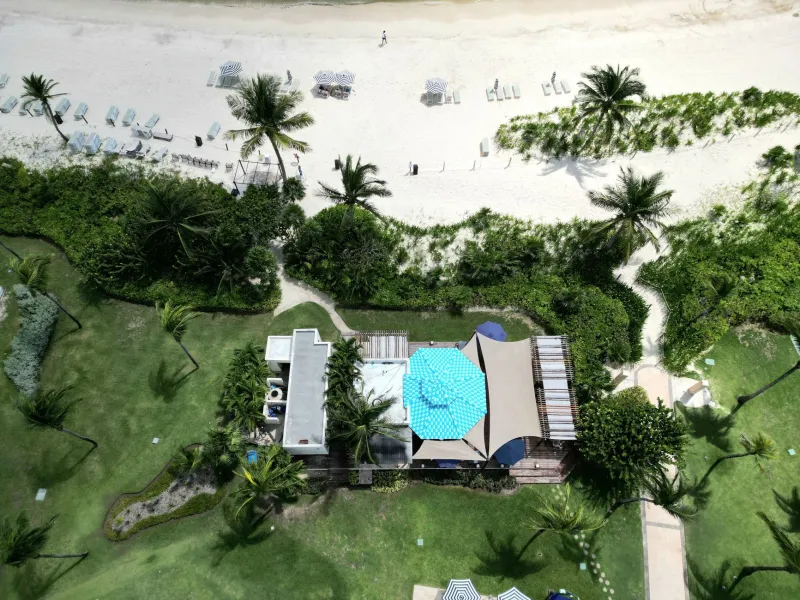
Naturally screened cabanas, thoughtfully positioned hedgerows, and the deliberate absence of branded backdrops all contribute to an atmosphere in which the instinct to document is quietly disarmed. When there is no obvious composition to chase, when the beauty of a place resists easy framing, guests find themselves drawn back into the experience itself rather than its representation.
This is not accidental. It is the result of a considered design philosophy that treats visual privacy as an amenity equal in importance to any other — one that requires the same care, investment, and ongoing attention.
The Member Compact
Perhaps the most powerful tool available to elite clubs is the culture of the membership itself. In the most exclusive circles, the unspoken agreement among guests carries more weight than any formal policy. Members understand — because they have sought out this particular environment precisely for this reason — that what occurs within these grounds belongs to the people present and to no one else.
This compact is reinforced in subtle ways. Clubs may host events specifically designed to be undocumentable — low-light dinners, intimate performances, gatherings structured around conversation rather than spectacle. The implicit message is clear: this evening is not for your followers. It is for you.
For certain members, particularly those whose professional lives place them under persistent public scrutiny, this compact is not merely pleasant — it is essential. The beach club becomes one of the very few spaces in their lives where they may be genuinely off-duty, not merely away from the office but liberated from the ambient pressure of visibility that defines modern public life.
Digital Presence Without Digital Exposure
None of this is to suggest that the finest beach clubs have retreated entirely from the digital world. They have not, nor would it serve their interests to do so. A thoughtfully maintained social presence — curated imagery, carefully considered language, content that evokes atmosphere without revealing specifics — serves both the club's commercial interests and its reputation for taste.
The distinction lies in who controls the narrative and how. When a club's visual identity is shaped by its own curatorial hand, it projects exactly what it intends: beauty, refinement, the suggestion of an experience rather than its documentation. What it does not project are the faces of its guests, the details of private events, or any image that might allow an outsider to feel as though they have attended what they have not.
This is the digital fluency that separates the truly sophisticated property from those that have merely adopted a veneer of exclusivity. The former understands that mystique is not the absence of presence — it is the careful management of what is revealed and what is permanently withheld.
The Deepest Luxury
There is an older understanding of luxury that the digital age has temporarily obscured but not extinguished. It holds that the finest things in life are not those most widely seen, but those most deeply felt. A meal consumed without the interruption of a photograph. A sunset witnessed without the mediation of a screen. An afternoon that will never be hashtagged, liked, or saved — only remembered.
The beach clubs that have built their reputations on this understanding are not swimming against the current of contemporary culture so much as offering refuge from it. They are places where guests are quietly, graciously invited to set down the burden of documentation and simply be — present at the water's edge, unobserved and entirely themselves.
In a world that cannot stop sharing, that invitation may be the most generous thing a host can offer.