From the Tides to the Table: How Elite Beach Clubs Are Championing Hyperlocal Coastal Cuisine
On a Tuesday morning in late spring, before the first guests have arrived for lunch, a chef at a private club on the South Carolina coast is standing at a dock, inspecting a cooler of just-caught sheepshead. The fisherman who brought it in has been working this stretch of water for thirty years. The chef has been cooking here for four. Their relationship — built on early morning conversations, mutual respect for the tidal rhythms that govern both their professions, and a shared conviction that the best ingredient is the one pulled from familiar water — is, in miniature, a portrait of a movement reshaping coastal dining at its most elevated level.
Across the United States, from the barrier islands of Georgia to the kelp-rich waters off the coast of Maine, a growing number of prestigious beach clubs are reconceiving their culinary identities around a single principle: that the most sophisticated thing a kitchen can do is to cook, with genuine depth and technique, the food that belongs to its place.
The Terroir of the Shoreline
The concept of terroir — that ineffable quality by which wine, cheese, or produce expresses the character of the soil, climate, and geography that produced it — has long been the province of land-based gastronomy. Its application to coastal cuisine is newer, but no less compelling.
Consider the difference between a blue crab pulled from the Chesapeake Bay and one harvested from the Gulf of Mexico. Both are the same species. Both are, by any objective measure, excellent. But they taste different — shaped by different water temperatures, different salinity levels, different diets. A chef who understands this distinction, and who builds a menu around the specific crabs available within twenty miles of the kitchen, is practicing a form of coastal terroir that no amount of imported luxury ingredient can replicate.
This is the argument being made, with increasing sophistication and conviction, by the culinary directors at some of America's most acclaimed beach clubs. The finest coastal dining, they contend, is not a matter of flown-in Wagyu or imported European delicacies. It is a matter of knowing your water, knowing your farmers, and possessing the technical mastery to let those ingredients speak.
Building the Supply Chain from the Shoreline Out
The practical work of sourcing hyperlocally in a coastal environment is considerably more complex than it might appear from a menu. Fishing is seasonal, weather-dependent, and inherently unpredictable. A storm can eliminate an entire week's planned catch. A red tide can close shellfish beds for a month. The chefs who do this work successfully are not simply committed to local sourcing in principle — they have built relationships, contingency plans, and menus flexible enough to accommodate the realities of working with wild and seasonal supply.
At several of the most celebrated clubs along the Gulf Coast, executive chefs have formalized these relationships through what amount to informal co-operative arrangements with small-scale fishing operations. The club commits to purchasing a guaranteed minimum quantity each week, providing the fishermen with economic stability. In return, the club receives first access to the most exceptional catches — the oversized Gulf red snapper, the early-season stone crab claws — before they reach the broader market.
Similar arrangements extend inland to the farms and orchards that supply produce, dairy, and foraged goods. A club in the Florida Panhandle might source its heirloom tomatoes from a single family farm forty minutes north, its honey from beekeepers working the longleaf pine flatwoods, and its goat cheese from a creamery whose herd grazes within sight of the Intracoastal Waterway. None of these ingredients are exotic. All of them are exceptional, and all of them tell a story that no import can.
The Chefs Reimagining Regional Identity
The culinary figures driving this movement are, almost uniformly, individuals who have made a deliberate choice to root themselves in a specific place rather than pursue the peripatetic career trajectories common in fine dining. Many trained in celebrated kitchens in New York, San Francisco, or abroad, then chose to bring those skills to a coastal region they consider home.
What they share is a commitment to what one Lowcountry-based chef describes as "cooking forward from the ingredient" — beginning not with a dish in mind but with what arrived at the kitchen door that morning, then determining, through technique and imagination, what it wants to become. A haul of Florida pompano might become a ceviche one day and a wood-grilled preparation with charred citrus the next, depending on the fish's size, fat content, and the vegetables available from the week's farm delivery.
This approach demands a different kind of culinary intelligence than the execution of a fixed menu. It requires deep knowledge of ingredients at various stages of freshness and size, familiarity with a wide range of techniques, and the confidence to improvise — all while maintaining the consistency of experience that guests at a luxury property rightfully expect.
Presentation as an Expression of Place
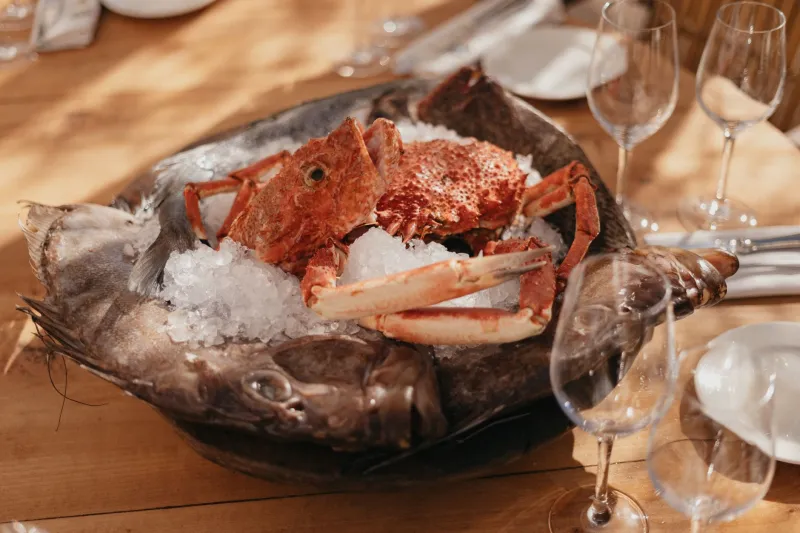
At the finest coastal clubs, the philosophy of local provenance extends beyond the ingredients themselves to the vessels and surfaces on which food is served. Ceramics commissioned from local potters, whose glazes echo the colors of the surrounding water and sand. Serving boards fashioned from reclaimed dock wood. Glassware hand-blown by regional artisans whose forms suggest the shapes of sea glass smoothed by decades of tidal movement.
These are not merely decorative choices. They are a continuation of the same argument made by the food itself: that this meal, in this place, could not have come from anywhere else. For the discerning guest, that specificity is its own form of luxury — perhaps the most genuine form available.
What to Seek as a Traveling Guest
For those planning a coastal stay with culinary discovery as a priority, a few markers reliably distinguish clubs that take this philosophy seriously from those that invoke it as marketing language.
First, look for menus that change frequently — ideally daily or weekly — and that name not just ingredients but their sources. A menu that reads "Gulf shrimp from Captain Ray Thibodaux, Apalachicola" is making a different promise than one that reads simply "Gulf shrimp."
Second, inquire whether the club offers any form of culinary engagement — tours of partner farms, fishing excursions with the club's supply partners, or chef's table experiences built around that morning's catch. The most committed programs treat these not as optional add-ons but as integral expressions of their identity.
Finally, pay attention to the bread basket and the butter. It is, admittedly, a small thing. But a club that sources its dairy from a local creamery and bakes its bread from regionally milled grain is signaling, in the most fundamental way, that its commitment to provenance begins at the beginning.
The Deeper Pleasure of Eating in Place
There is a satisfaction particular to eating food that could only exist where you are — a satisfaction distinct from, and in some ways deeper than, the pleasure of technical excellence alone. It is the pleasure of genuine encounter: with a landscape, a season, and the people whose labor and knowledge made the meal possible.
The most thoughtful beach clubs understand this. They have come to see their dining programs not merely as an amenity but as a form of hospitality in the fullest sense — an introduction to the place, its character, and its people, offered through the most immediate and intimate medium available. For the traveler who arrives at the shore seeking not just comfort but connection, there is no more eloquent welcome than a plate that tastes, unmistakably, of where you are.